
Buffalo County DEC program drawing attention, support from area organizations

by Beth Kraft
Drug-related arrests can come with a strong stigma against the user and their perceived blatant disregard for the law or anything else beyond getting their next fix. Equally disturbing is the number of voiceless victims—children—that can sometimes get caught in the middle of an addiction situation.
With a growing trend in drug abuse cases, particularly methamphetamine, all across Wisconsin, Buffalo County is one of many to form a Drug Endangered Children (DEC) Team to align resources and create a uniform plan of action that doesn’t simply end at the time of a drug bust.
“It’s not just focusing on what the parents did wrong,” explains Amy Reggin, a Buffalo County social worker and one of several involved in DEC Team activities. “It’s really a follow-through of services for the parents as well as services for the kids. Addiction is a nasty thing.”
Buffalo County Sheriff Michael Schmidtknecht agrees there has been a “drastic upturn” in the number of methamphetamine-related cases in the county over the past few years.
Specifically, since the beginning of the new year, approximately one-third to half of the Buffalo County Jail’s 41 bookings “have either direct or indirect connection to drugs,” Schmidtknecht stated.
Instances of “drugged driving” offenses—driving under the influence of narcotics—have also risen sharply.
Schmidtknecht says previously “drugged driving” arrests were unheard of, but now “we can almost count on one every month or two.”
The steady uptick in drug-related incidents encouraged a number of county departments, including Buffalo County Health and Human Services, county and local law enforcement agencies and the district attorney’s office, to pool their resources on behalf of children who are exposed to unsafe conditions as a result of drug activity.
“The drug issue in our community continues to grow,” Reggin said. “We were already kind of doing the DEC protocol but we just wanted it to be more formal where every single case was handled the same from the beginning starting with the investigation through prosecution.”
The group is behind the creation of the DEC bag, given to each child removed from a home where drugs are present. The bags include a blanket, change of clothes, personal care items and a toy to take with them when they are placed with relatives or in foster care.
Reggin explains that in many cases, particularly if meth was the drug of choice, the children cannot take any items with them—no clothing, no blankets, not even their favorite stuffed animal—when they are removed from their home.
“The residue of meth can stick to any porous surface,” Reggin said, noting fabrics and carpets harbor the drug and expose children to meth even though they clearly aren’t using.
“That’s what we were seeing was that many, many of our kids were testing at high levels for meth,” said Reggin.
Since the local DEC Team’s inception about a year ago, the group has collaborated to assist 12 families and 26 children, Reggin said.
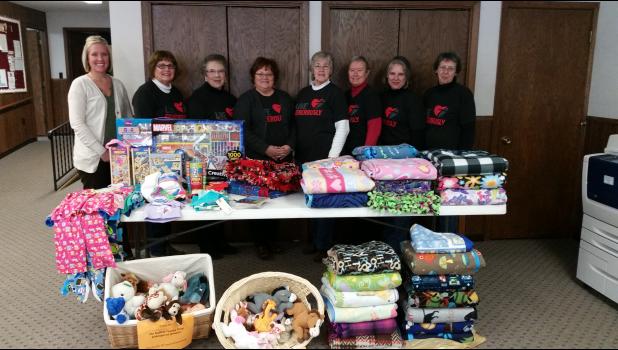
Many of those children have been assisted thanks to the efforts of groups like the Zion Quilters, who recently donated a large haul of fleece blankets, clothing, stuffed animals, games, toys and coloring books to help boost the DEC Team’s supplies for kids’ go-bags.
As part of a Thrivent Action Team project, the Mondovi-based quilting group turned 90 yards of fleece into 30 fleece blankets and collected many of the other items with help from members at Zion Lutheran Church.
“We gave out four the next week,” said Reggin of the blankets donated by the Zion Quilters. “The kids love them; it’s just something to call their own.”
In some cases it’s possible that children coming from a drug-endangered situation haven’t had access to something as simple as a clean blanket in awhile. That’s why it’s not a stretch to see children listed as victims in case files, even though they aren’t the ones struggling with addiction.
“They can utilize services in the future,” Reggin shared. “Any counseling services, any addiction services for themselves—it really helps get them services because they were a victim of drug abuse.”
One could call the parents selfish, but the bottom line is they have a problem they need help solving, Reggin stressed.
Drug treatment is just a piece of that puzzle to go along with therapy, counseling and in-home counseling once the parents can be reunited with their children.
A single DEC case can stretch for a year or more after the initial drug arrest and removal of the children from a drug-endangered home, Reggin said.
It’s a testament to the resources DEC can offer to help adults maintain sobriety in the “real world.”
“There are some people that it’s a huge life-changer and they’re never going to touch drugs again, and then there are some that are truly addicted and it takes a long time,” said Reggin.
“It’s scary what addiction can do to anybody...it’s everywhere,” she added.
Part of the DEC Team’s mission is to break the cycle of drug abuse by focusing on the kids.
Cindy Giese, a Mondovi resident and the statewide DEC coordinator through her position with the Wisconsin Department of Justice’s Department of Criminal Investigations, notes the DEC Team helps bring awareness to an underground problem in the community.
“A lot of these kids are in survival mode 24/7,” said Giese, noting that eating, getting sleep uninterrupted and even getting to school regularly can be a struggle due to their parents’ drug abuse or trafficking activities.
“The drug culture is a very unique culture,” Reggin said. “So often the kids learn to get what they need because they’re not getting it from anyone else.”
As the statewide coordinator, Giese was excited to see her home county join the list of those with DEC teams last year.
“I’ve been pushing for it,” she said. “Once they grabbed onto it they were exceptional.”
The idea for DEC was first introduced in Wisconsin through a focus group in 2004. The state now holds the highest number of local DEC programs in the nation, Giese said.
In west central Wisconsin, every county, with the exception of Pepin and Jackson counties, has an active DEC program.
“Our goal is to have every county in the state have a DEC program,” Giese said.
Bringing a heightened sense of awareness to the community about drug addiction and the ripple effect it often causes is another area of focus for DEC Team members.
Reggin says DEC has helped her educate EMTs, fire departments and other organizations throughout the county.
“We just want everyone to know what it is and how to make a report,” she said. “Most people don’t realize how far-reaching drug addiction can be.”
In addition to raising awareness in the community, efforts to educate have also yielded a variety of donations to assist the program.
Buffalo County 4-H has made supporting DEC its service learning project for 2016. Local businesses are also helping out with items for DEC bags, such as dental care packs from Midwest Dental and the bags themselves from Tractor Central. Monetary donations from various individuals and groups like the Mondovi Area Thrift Shop are also a big help, Giese and Reggin agree.
Clothes and shoes in various sizes are high on the needs list. Toys for kids of all ages can also come in handy during long waits in the ER for medical checks after kids are turned over to CPS—part of DEC protocol.
Gift cards in small amounts for stores like Walmart or Target can also be helpful for kids to purchase other toiletries they might need beyond what’s in their DEC bags, Reggin said.
In addition to helping children and families lead healthier lives drug-free, Reggin notes DEC has also fostered improved collaboration between all departments involved in drug cases rather than each doing their own job separately.
“Now it’s just one collaboration and I feel like it utilizes the same resources for one, long case,” she said.
Giese praised the ongoing efforts of Buffalo County’s DEC Team, noting reps who spoke at a recent conference helped encourage some of the state’s other, smaller counties that they could pull off a DEC Team, too.
“They’ve got a dedicated team that works well together,” Giese said.
Reggin said the program “isn’t set in stone” as it continues to evolve.
“Every case throws in something new,” she said. “It’s been a really good learning experience and it’s something we’ll continue to make stronger for the county and the community.”
For more information about Buffalo County’s DEC Team, contact Buffalo County Health and Human Services at (608) 685-4412 or dhhs@buffalocounty.com.
